You Pull Away When You Care.
Here’s How To Stay Connected—Without Performing.
You Pull Away When You Care.
Here’s How To Stay Connected—Without Performing.
For avoidant-leaning people who need words—not more inner work.
For avoidant-leaning people who need words—not more inner work.






+10k
Already Used By Thousands
+10k
+10k
Already Used By Thousands
You Pull Away When You Care.
Here’s How To Stay Connected—Without Performing.
For avoidant-leaning people who need words—not more inner work.
+10k
+10k
Already Used By Thousands
A therapist once told me something quietly:
“Most people don’t need more healing. They just need better words for the moments they go quiet.”
She wasn’t selling anything.
She was naming what so many of us feel:
You pull away even when you care.
And it’s not because you’re broken—it’s because you’ve never had language that fits your nervous system.
This guide gives you that language.
Not to change yourself.
But to stay connected—without performing.
A therapist once told me something quietly:
“Most people don’t need more healing. They just need better words for the moments they go quiet.”
She wasn’t selling anything.
She was naming what so many of us feel:
You pull away even when you care.
And it’s not because you’re broken—it’s because you’ve never had language that fits your nervous system.
This guide gives you that language.
Not to change yourself.
But to stay connected—without performing.
A Toolkit with Exact Words To Say—And Simple Actions To Take—When You Shut Down But Still Care.
One place. No extra work.
One place. No extra work.
What This Actually Is
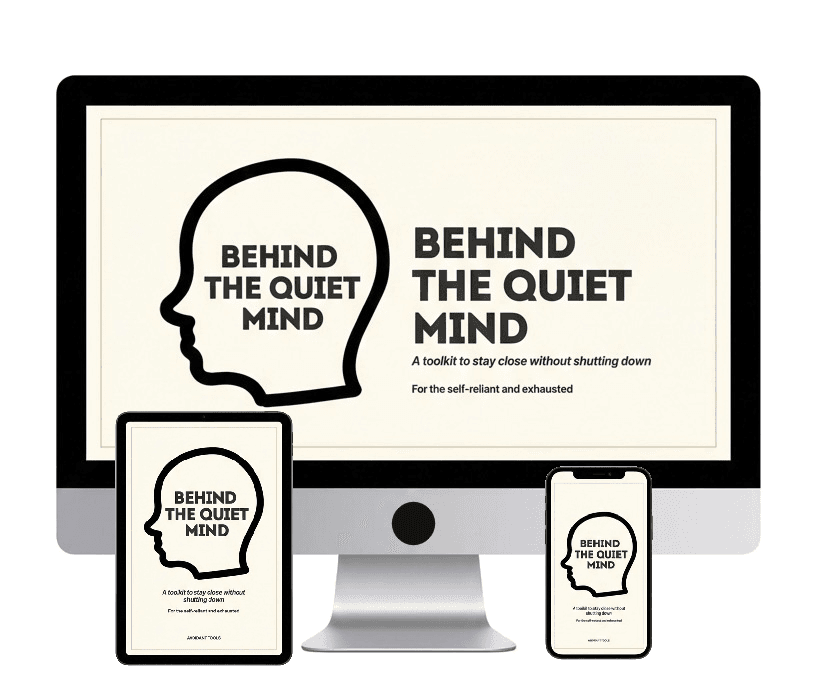
Behind The Quiet Mind isn't a book. It's a 6 module guide—this is where you'll find:
Exact phrases to use when someone says, "You're so distant"
A 3-step internal checklist to pause without vanishing and trying to find an escape
Guilt-neutralizing phrases that reframe your quiet as self-care—not rejection
Micro-actions to gently return to your body when you’re numb
Ways to reconnect after pulling away that don't take up your energy
No journaling. No vulnerability drills. No "inner child" work, or pushing yourself to be more vulnerable.
It's for people who shut down under pressure—and just need exact phrases to use in the moment.
What This Actually Is
Behind The Quiet Mind isn't a book. It's a 6 module guide—this is where you'll find:
Exact phrases to use when someone says, "You're so distant"
A 3-step internal checklist to pause without vanishing and trying to find an escape
Guilt-neutralizing phrases that reframe your quiet as self-care—not rejection
Micro-actions to gently return to your body when you’re numb
Ways to reconnect after pulling away that don't take up your energy
No journaling. No vulnerability drills. No "inner child" work, or pushing yourself to be more vulnerable.
It's for people who shut down under pressure—and just need exact phrases to use in the moment.
What This Actually Is
Behind The Quiet Mind isn't a book. It's a 6 module guide—this is where you'll find:
Exact phrases to use when someone says, "You're so distant"
A 3-step internal checklist to pause without vanishing and trying to find an escape
Guilt-neutralizing phrases that reframe your quiet as self-care—not rejection
Micro-actions to gently return to your body when you’re numb
Ways to reconnect after pulling away that don't take up your energy
No journaling. No vulnerability drills. No "inner child" work, or pushing yourself to be more vulnerable.
It's for people who shut down under pressure—and just need exact phrases to use in the moment.
This Is For You If:
• You're tired of being called "cold" for needing some space
• You are aware of being an avoidant—You now just need practical language
• You want tools that respect your autonomy, not challenge it
• You'd rather have a clear guide that works than 200 pages of theory that leaves you more exhausted
What's Inside:
6 Core Modules + Ready-To-Use Tools:
Module 1: The Quiet Science of Shutting Down
Understand why numbness, fog, and fatigue are your nervous system’s protective shutdown—not laziness.
Module 2: The Logic of Leaving: Strategic Recalibration
Learn how to pause without ghosting, using clear scripts that honor your limits and reduce their anxiety.
Module 3: Boundary Intelligence: Neutralizing Guilt and Blame
Replace self-blame with guilt-neutralizing phrases that reframe your quiet as self-care, not rejection.
Module 4: The Action Paradox: Why “Just Do It” Feels Like Self-Betrayal
Use the Smarter Question to act from clarity—not compulsion—so you don’t disappear to please others.
Module 5: The Micro-Action Reset: Moving From Numbness to Presence
Gently return to your body with micro-actions that require zero energy.
Module 6: Rebuilding Trust: Quiet Connection and Integrity-Based Returns
Reconnect after distance with honest, low-effort phrases that build trust—without apology or performance.
From People Who Use This:
“I usually pull away when relationships start feeling good. I text less, cancel plans, and tell people I’m busy when I’m really just on my couch. This book explained why I do that, but more importantly, it gave me real words to use instead of disappearing. I tried one of them with a friend and didn’t lose the relationship. That alone made this worth it 🙏”

Emma Briggs
"Didn’t expect much from this, but it actually helped! I knew I was a people pleaser, but I never realized how much it was connected to my avoidance. I over-give, say yes to everything, then feel resentful and disappear when I get overwhelmed. This guide helped me see the pattern clearly and showed me how to slow it down instead of swinging between people-pleasing and shutting down. I started saying no earlier and explaining myself instead of ghosting."

Giovanni D'Amico
"For the first time, I could explain what I needed. I don't feel like a bad person anymore. I felt guilty for pulling away, then guilty for staying. This helped break that cycle.”

Sabina Kurti
Why This Works
The guide becomes personal the moment you recognize yourself in it—not as someone who needs to be fixed,
But as someone who didn't know how to respond when triggered.
Therapy often tries to decode who you are— to trace your reactions back to a root cause and label every feeling as a symptom to unpack.
This guide skips all that.
It already understands why you shut down.
It simply hands you what was missing:
Instead of analysis, it gives you clear, immediate steps to use in real-time—so you can stay connected without losing yourself.
All for $20— less than a therapy session.
If you're still reading, you already know this:
You're not here for insight.
You’re here because you’re tired of going quiet when things matter—and having no way back that feels like you.
What you feel right now—that pull in your chest, that small pressure—isn’t confusion.
It’s clarity trying to get your attention.
This is the moment you choose:
keep repeating the same silent exit…
or try something that gives you a different way through.
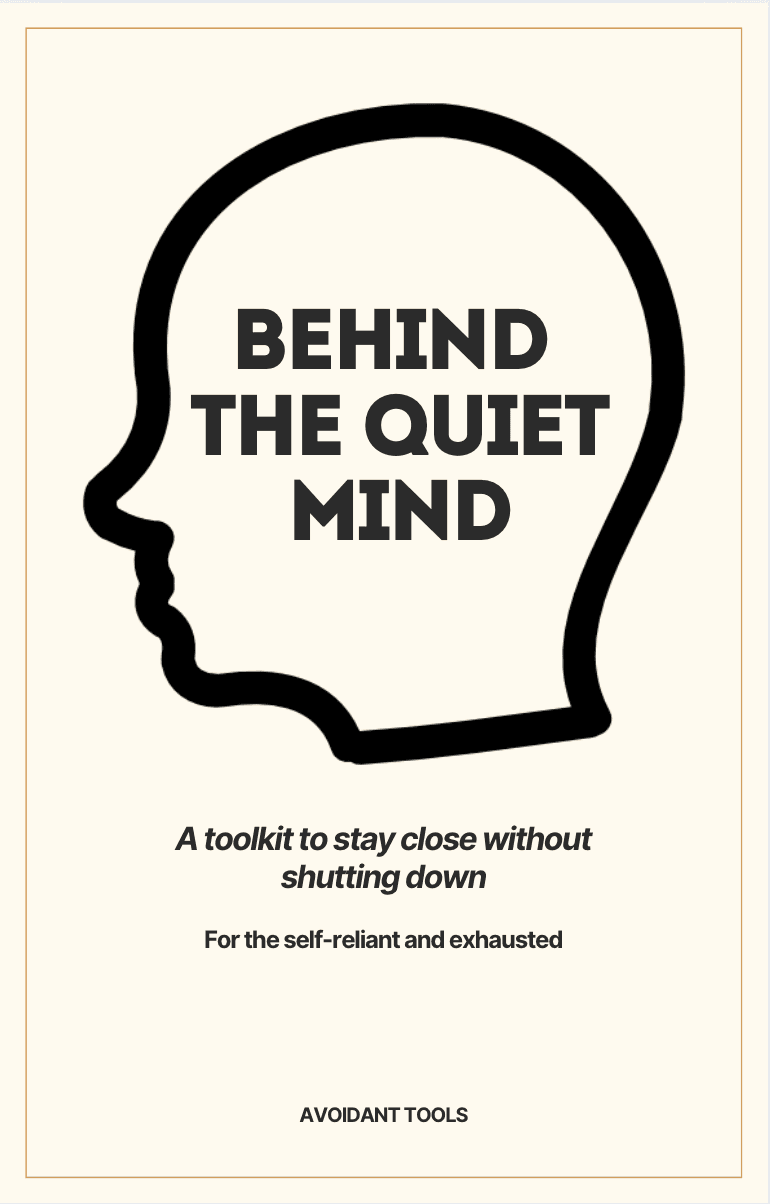
Behind The Quiet Mind
This Is For You If:
• You're tired of being called "cold" for needing some space
• You are aware of being an avoidant—You now just need practical language
• You want tools that respect your autonomy, not challenge it
• You'd rather have a clear guide that works than 200 pages of theory that leaves you more exhausted
What's Inside:
6 Core Modules + Ready-To-Use Tools:
Module 1: The Quiet Science of Shutting Down
Understand why numbness, fog, and fatigue are your nervous system’s protective shutdown—not laziness.
Module 2: The Logic of Leaving: Strategic Recalibration
Learn how to pause without ghosting, using clear scripts that honor your limits and reduce their anxiety.
Module 3: Boundary Intelligence: Neutralizing Guilt and Blame
Replace self-blame with guilt-neutralizing phrases that reframe your quiet as self-care, not rejection.
Module 4: The Action Paradox: Why “Just Do It” Feels Like Self-Betrayal
Use the Smarter Question to act from clarity—not compulsion—so you don’t disappear to please others.
Module 5: The Micro-Action Reset: Moving From Numbness to Presence
Gently return to your body with micro-actions that require zero energy.
Module 6: Rebuilding Trust: Quiet Connection and Integrity-Based Returns
Reconnect after distance with honest, low-effort phrases that build trust—without apology or performance.
This Is For You If:
What's Inside:
• You're tired of being called "cold" for needing some space
• You are aware of being an avoidant—You now just need practical language
• You want tools that respect your autonomy, not challenge it
• You'd rather have a clear guide that works than 200 pages of theory that leaves you more exhausted
6 Core Modules + Ready-To-Use Tools:
Module 1: The Quiet Science of Shutting Down
Understand why numbness, fog, and fatigue are your nervous system’s protective shutdown—not laziness.
Module 2: The Logic of Leaving: Strategic Recalibration
Learn how to pause without ghosting, using clear scripts that honor your limits and reduce their anxiety.
Module 3: Boundary Intelligence: Neutralizing Guilt and Blame
Replace self-blame with guilt-neutralizing phrases that reframe your quiet as self-care, not rejection.
Module 4: The Action Paradox: Why “Just Do It” Feels Like Self-Betrayal
Use the Smarter Question to act from clarity—not compulsion—so you don’t disappear to please others.
Module 5: The Micro-Action Reset: Moving From Numbness to Presence
Gently return to your body with micro-actions that require zero energy.
Module 6: Rebuilding Trust: Quiet Connection and Integrity-Based Returns
Reconnect after distance with honest, low-effort phrases that build trust—without apology or performance.
From People Who Use This:
“I usually pull away when relationships start feeling good. I text less, cancel plans, and tell people I’m busy when I’m really just on my couch. This book explained why I do that, but more importantly, it gave me real words to use instead of disappearing. I tried one of them with a friend and didn’t lose the relationship. That alone made this worth it 🙏”
Emma Briggs
“I usually pull away when relationships start feeling good. I text less, cancel plans, and tell people I’m busy when I’m really just on my couch. This book explained why I do that, but more importantly, it gave me real words to use instead of disappearing. I tried one of them with a friend and didn’t lose the relationship. That alone made this worth it 🙏”
Emma Briggs
"Didn’t expect much from this, but it actually helped! I knew I was a people pleaser, but I never realized how much it was connected to my avoidance. I over-give, say yes to everything, then feel resentful and disappear when I get overwhelmed. This guide helped me see the pattern clearly and showed me how to slow it down instead of swinging between people-pleasing and shutting down. I started saying no earlier and explaining myself instead of ghosting."
Giovanni D'Amico
"Didn’t expect much from this, but it actually helped! I knew I was a people pleaser, but I never realized how much it was connected to my avoidance. I over-give, say yes to everything, then feel resentful and disappear when I get overwhelmed. This guide helped me see the pattern clearly and showed me how to slow it down instead of swinging between people-pleasing and shutting down. I started saying no earlier and explaining myself instead of ghosting."
Giovanni D'Amico
"For the first time, I could explain what I needed. I don't feel like a bad person anymore. I felt guilty for pulling away, then guilty for staying. This helped break that cycle.”
Sabina Kurti
"For the first time, I could explain what I needed. I don't feel like a bad person anymore. I felt guilty for pulling away, then guilty for staying. This helped break that cycle.”
Sabina Kurti
“I usually pull away when relationships start feeling good. I text less, cancel plans, and tell people I’m busy when I’m really just on my couch. This book explained why I do that, but more importantly, it gave me real words to use instead of disappearing. I tried one of them with a friend and didn’t lose the relationship. That alone made this worth it 🙏”
Emma Briggs
“I usually pull away when relationships start feeling good. I text less, cancel plans, and tell people I’m busy when I’m really just on my couch. This book explained why I do that, but more importantly, it gave me real words to use instead of disappearing. I tried one of them with a friend and didn’t lose the relationship. That alone made this worth it 🙏”
Emma Briggs
"Didn’t expect much from this, but it actually helped! I knew I was a people pleaser, but I never realized how much it was connected to my avoidance. I over-give, say yes to everything, then feel resentful and disappear when I get overwhelmed. This guide helped me see the pattern clearly and showed me how to slow it down instead of swinging between people-pleasing and shutting down. I started saying no earlier and explaining myself instead of ghosting."
Giovanni D'Amico
"Didn’t expect much from this, but it actually helped! I knew I was a people pleaser, but I never realized how much it was connected to my avoidance. I over-give, say yes to everything, then feel resentful and disappear when I get overwhelmed. This guide helped me see the pattern clearly and showed me how to slow it down instead of swinging between people-pleasing and shutting down. I started saying no earlier and explaining myself instead of ghosting."
Giovanni D'Amico
"For the first time, I could explain what I needed. I don't feel like a bad person anymore. I felt guilty for pulling away, then guilty for staying. This helped break that cycle.”
Sabina Kurti
"For the first time, I could explain what I needed. I don't feel like a bad person anymore. I felt guilty for pulling away, then guilty for staying. This helped break that cycle.”
Sabina Kurti
Why This Works
The guide becomes personal the moment you recognize yourself in it—not as someone who needs to be fixed,
But as someone who didn't know how to respond when triggered.
Therapy often tries to decode who you are— to trace your reactions back to a root cause and label every feeling as a symptom to unpack.
This guide skips all that.
It already understands why you shut down.
It simply hands you what was missing:
Instead of analysis, it gives you clear, immediate steps to use in real-time—so you can stay connected without losing yourself.
All for $20— less than a therapy session.
If you're still reading, you already know this:
You're not here for insight.
You’re here because you’re tired of going quiet when things matter—and having no way back that feels like you.
What you feel right now—that pull in your chest, that small pressure—isn’t confusion.
It’s clarity trying to get your attention.
This is the moment you choose:
keep repeating the same silent exit…
or try something that gives you a different way through.
Behind The Quiet Mind
Why This Works
The guide becomes personal the moment you recognize yourself in it—not as someone who needs to be fixed,
But as someone who didn't know how to respond when triggered.
Therapy often tries to decode who you are— to trace your reactions back to a root cause and label every feeling as a symptom to unpack.
This guide skips all that.
It already understands why you shut down.
It simply hands you what was missing:
Instead of analysis, it gives you clear, immediate steps to use in real-time—so you can stay connected without losing yourself.
All for $20— less than a therapy session.
If you're still reading, you already know this:
You're not here for insight.
You’re here because you’re tired of going quiet when things matter—and having no way back that feels like you.
What you feel right now—that pull in your chest, that small pressure—isn’t confusion.
It’s clarity trying to get your attention.
This is the moment you choose:
keep repeating the same silent exit…
or try something that gives you a different way through.